Kino v3.0 is not just a better body-fat model. It is a new class of model from Kino: one that blazes forward towards Kino's north start of democratizing access to powerful and personalized health software.
The KINO model family has been improving along a pretty clear logarithmic-line from our last few releases; however, v3.0 is where that line starts to bend. v3.0's body fat performance improved - disproportionately to previous model updates. Further, v3.0 is the first KINO model that can estimate lean mass %, visceral fat, and even limb-level lean mass from pure image-data. These new targets aren't random either, they meet Kino's production-standard - consistency that makes the output meaningful and actually useful.
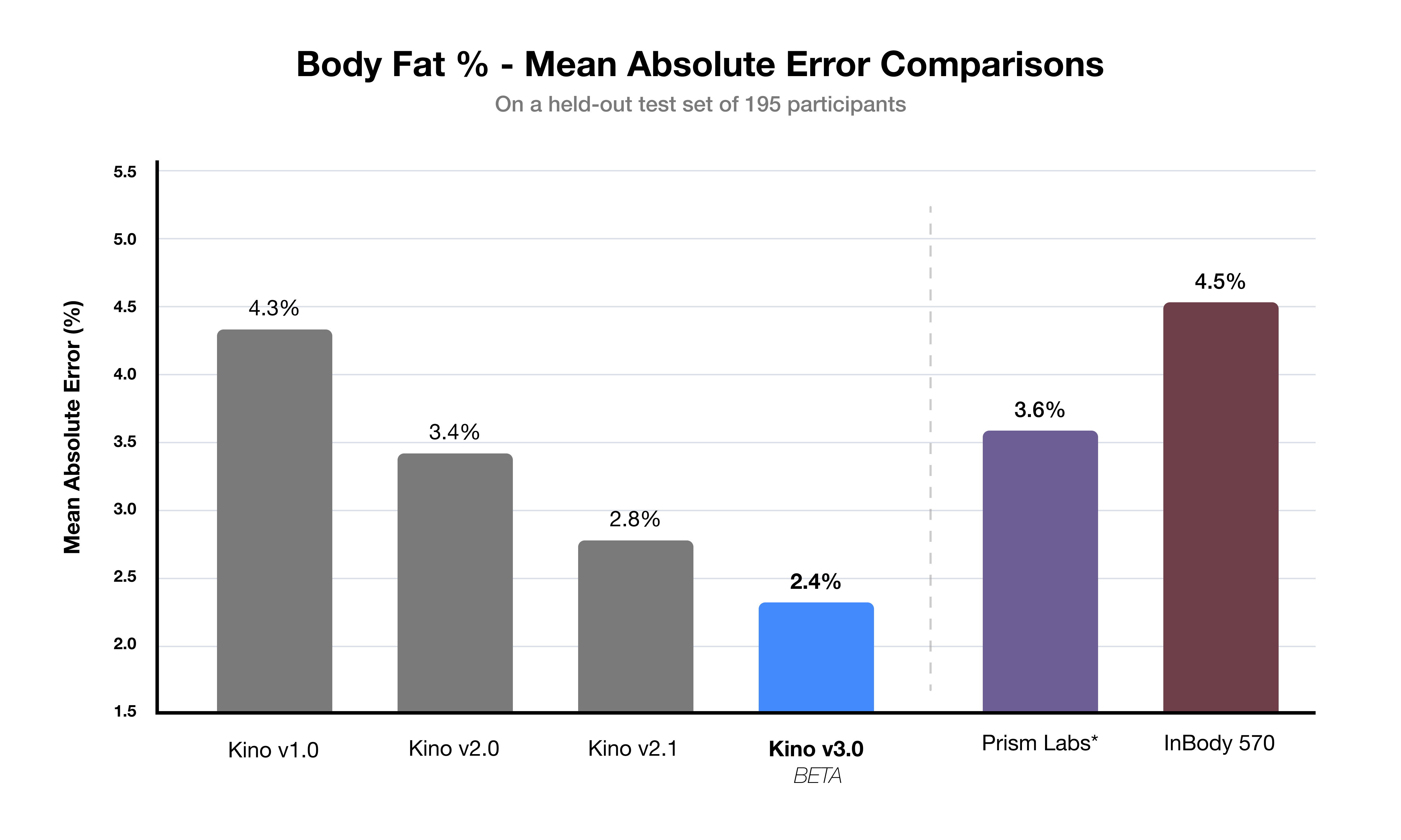
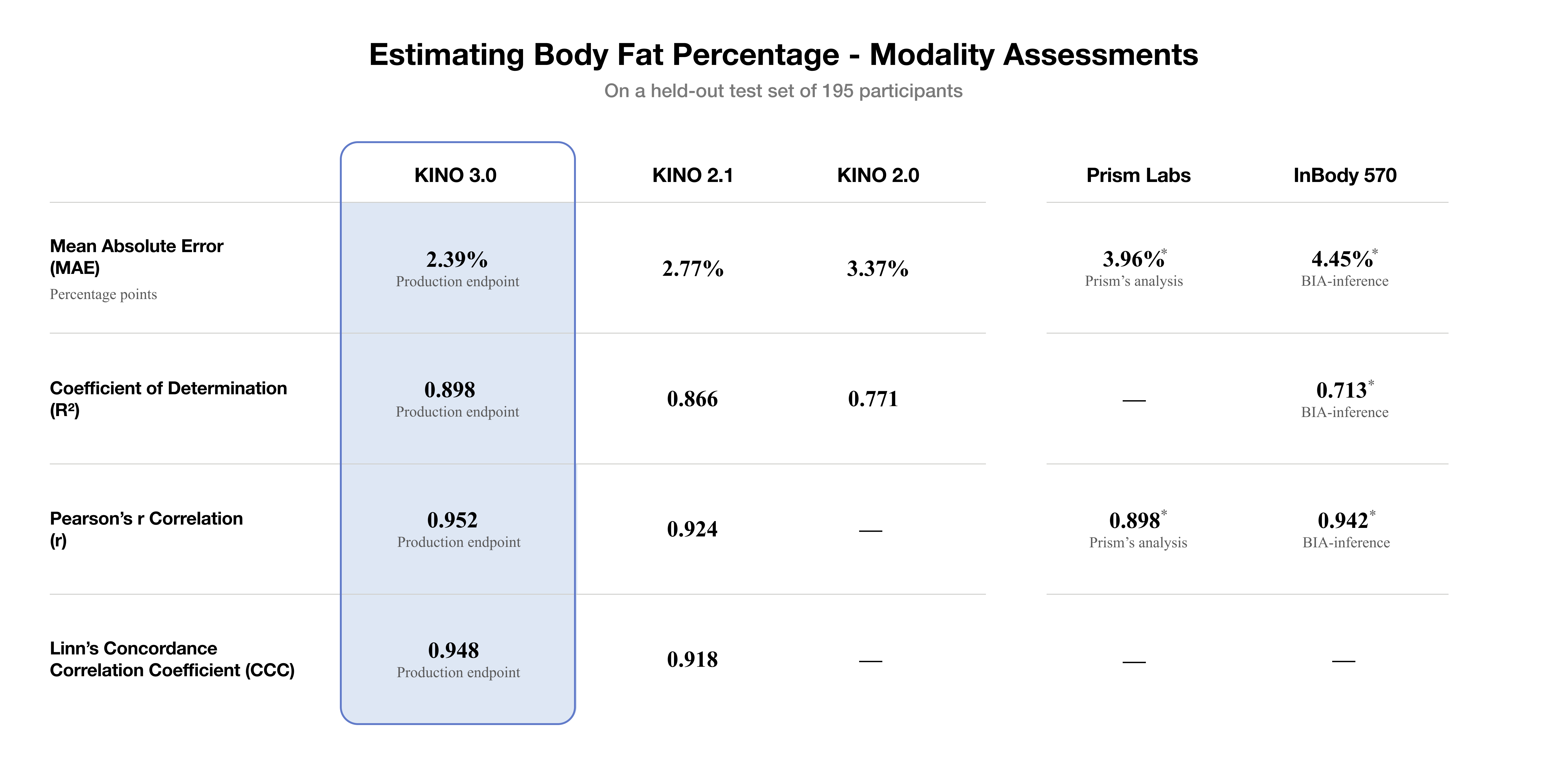
On our held-out set of 195 participants, Kino v3.0 reached a 2.39 percentage-point mean absolute error for body-fat percentage, while explaining 89.8% of the variation in DEXA body-fat estimates. Those are our strongest body-fat results yet, and the best performing body compositon metrics by any 'visual body compositon' system to date.
on our held-out test set1
against DEXA estimates2
with production endpoints
A new trend emerges
In June 2026, v2.1 proved that visual body composition exhibited gains from scale in compute and data. v3.0 carries that accuracy forward, but at a steeper angle of ascent than we have witnessed in previous KINO models. Outsized accuracy improvements can be attributed to a novel model-level approach (architecture level updates). These accuracy improvements in body fat extend to other targets as well, such as lean mass percentage, visceral adipose tissue, and lean mass by arm and leg.
The picture comes into focus
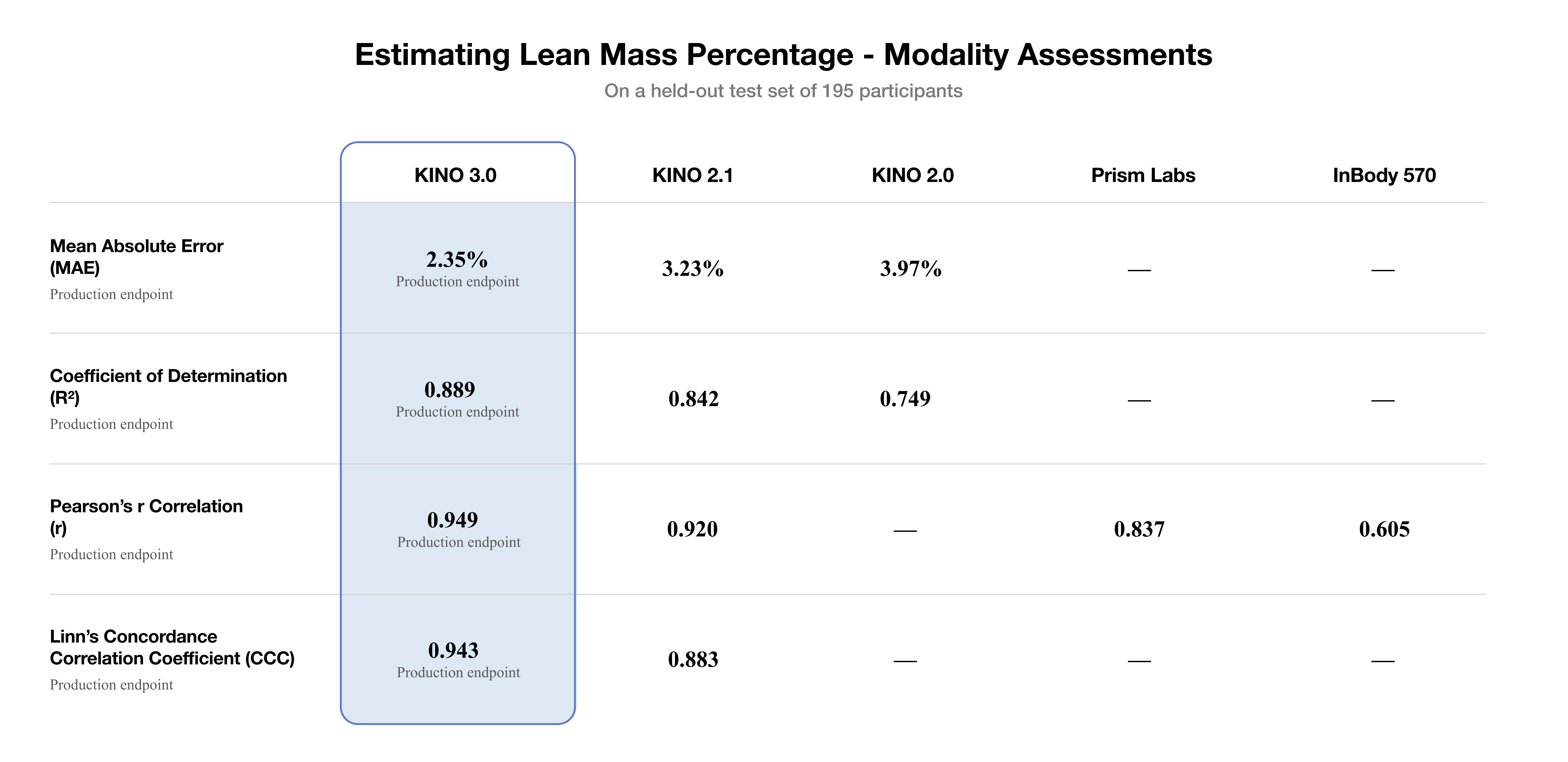
We are especially excited about what v3.0 can see beyond body fat. For starters, lean-mass percentage estimate improved to 2.35% MAE and an R2 of 0.889. This represents a meaningful improvement in Kino's production technology, as lean mass is now an independently derived feature with similar performance to Kino's body fat model.
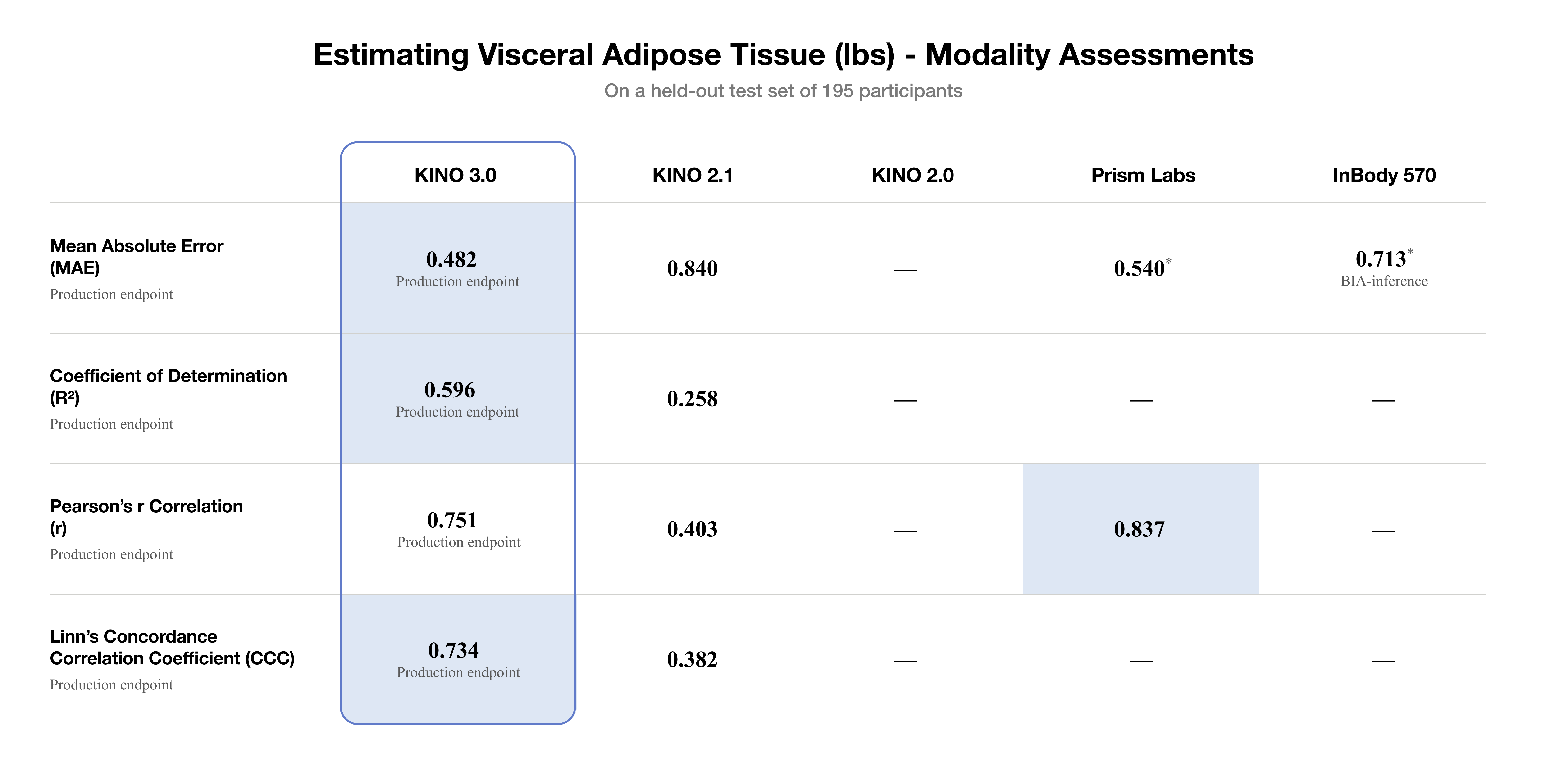
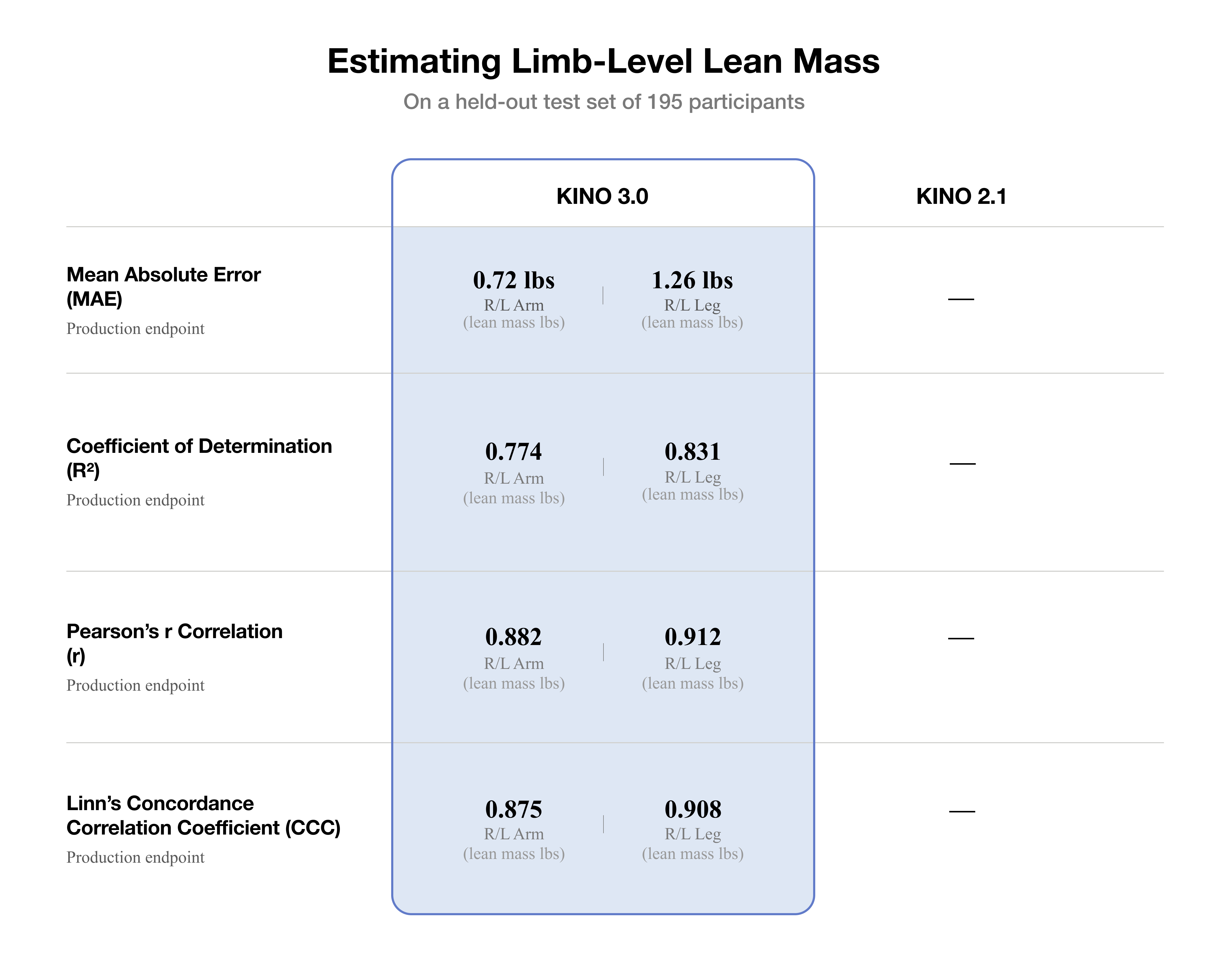
An exciting new addition to the KINO production endpoint is visceral adipose tissue, which clocked a 0.482 lbs MAE and an R2 of 0.596 - more than doubling the explanatory power of v2.1 on that measure. Although performance is weaker than our body fat and lean mass models, we are excited by the performance in these new metrics (namely VAT), and we'll continue to seek gains for improved architecture and dataset size. Further, for the first time, KINO models can now estimate lean mass at the limb level, separately for arms and legs. With VAT and ALM-level predictions, Kino begins exploring application in more clinically-meaningful metrics as we explore eventual regulatory status.
Better numbers, better conversations
For a coach, clinician, or fitness professional, the value here is not just another report card. It is a better conversation (and relationship) with the person in front of you. You can talk about muscle retention during weight loss, see whether an intervention is changing the signal you care about, or have a more grounded discussion when the scale is telling an incomplete story.
There is still work to do. These are estimates, not diagnoses, and a KINO scan should not replace medical advice, DEXA, or a clinical evaluation. But v3.0 moves the product into a very different place: useful enough to see the composition changes that used to be invisible between lab visits. As Kino progresses our technology, our north star remains the same - we're on a mission to democratize access to mobile health tools. KINO v3.0 is a very real step forward in achieving this goal, and we're excited to share it with you.
Availability
KINO v3.0 is now live in beta for Kino partners. Existing partners can use it at no additional cost while we continue to monitor results in production and tighten the experience around these new outputs.
For API partners, KINO v3.0 BETA is available at no extra cost. However, our endpoints will phase in deployment of these new models to test real world performance, latency, and other production-forward metrics that could impact your users' experience.
Interested in bringing Kino v3.0 to your stack or practice? Reach out to jacksongerard@kino-fitness.com.
Notes on the evaluation
- Body-fat MAE is the mean absolute difference between Kino and Hologic DEXA body-fat percentage on a held-out set of 195 participants.
- R2 describes the share of variation in the DEXA estimate accounted for by the Kino estimate. It is reported here on the same held-out test set.
- All comparisons in the accompanying figures use the endpoints and methods shown in the figures. Results from third-party systems are included as shown in the respective analyses and should not be interpreted as independent head-to-head clinical validation.
- Kino is not a medical device. Its outputs are informational estimates and are not intended to diagnose, treat, cure, or prevent any disease.